Healthcare Excellence Canada’s Health Equity Framework Implementation Guides
These practical implementation guides can help organizations, teams, and individuals put the HEC Health Equity Framework into action.
- Topics
- Health equity
- Patient engagement
- Patient safety
- Audience
Quality or safety improvement lead
Healthcare leader
Point of care provider


Implementation guides: Building a Foundation for Health Equity
Advancing health equity takes more than good intentions — it takes action. These co-developed implementation guides can help teams move from understanding health equity to putting that understanding into practice.
There’s no single path to applying the Health Equity Framework. However, these implementation guides work best when connected to work already happening in a healthcare setting. As you explore them, think about a current or upcoming initiative where these tools could make a difference.
Start here: How to plan and Implement priority actions
This planning guide is designed to help you and your team decide where to focus efforts and how to get started, based on your community's priorities, your organizational context and the resources available. Whether you are beginning new work or strengthening existing efforts, this tool can help you choose priority areas for action, build shared purpose and role clarity, and begin developing an action plan.
Throughout the guide, you’ll find five companion resources designed to spark conversation and highlight where you can take action as an individual, a team, and an organization. Each resource takes a deeper look at ways to implement health equity work at different stages of your planning. These resources are available separately if you’d like to explore them individually.
Guiding Commitments
This resource introduces six key commitments to help ensure that health equity work is grounded in strong foundational principles and approached with humility, care and accountability – so that HEC’s Health Equity Framework can be applied in meaningful and sustainable ways.
Co-developed alongside the framework, the following guiding commitments represent essential starting points for advancing equity in health systems and services:
Reflect deeply
Recognize intersectionality
Adopt an anti-racism and anti-oppressive approach
Develop trauma awareness
Build relationships based on trust and accountability
Commit to learning and unlearning
How to use this resource
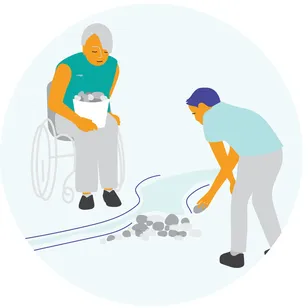
Use this resource and reflective questions to build shared language and understanding of health equity work with your team.
Reflect on each guiding commitment individually, then discuss as a group. You may decide to select one guiding commitment as a starting point.
Use the guiding commitments to ground your work in shared language and values before you implement the actions of the HEC Health Equity Framework.
Revisit these commitments regularly as your work evolves.
Using Your Influence to Support Change
This resource helps you identify opportunities within your role, relationships and organization to drive health equity work forward.
Health inequities are shaped by systems and structures that create and perpetuate unequal conditions to care. Creating meaningful change requires recognizing and addressing these factors. A starting point is understanding where you have influence and what actions you can take to shift the conditions that impact health.
How to use this Resource

Use this resource during the early stages of health equity work.
Use the guiding questions below to help identify actions you can take within your sphere of influence. Afterwards, you may want to share your reflections with colleagues or team members in pairs or through a group discussion to explore how your individual spheres of influence connect and contribute to your team’s collective action on health equity.
Combine this resource with other tools that support implementation of health equity initiatives.
How Your Team can Make Change
This resource supports teams to explore what’s possible for advancing health equity work together.
Advancing health equity is a shared effort that relies on collaboration, conversation and collective action. By reflecting on shared strengths, systemic barriers and opportunities for change – while also considering the realities of their organizational context – teams can identify where they are best positioned to take action on health equity.
How to use this resource

Bring this reflection tool to team pre-planning sessions for health equity work or strategy development, and use the questions below to inform dialogue and identify areas for growth and action.
Use this resource with other implementation guides. The following resources from the HEC Health Equity Framework might be relevant:
Using your influence to support change: This resource helps identify actions you can take within your own sphere of influence.
Guiding commitments: This resource helps to align your work with team, partner and organization commitments to health equity.
How to Build an Accountability Agreement
This resource is designed to spark reflection and guide your team in planning your own accountability agreement with the communities that you are working with.
An accountability agreement is a shared commitment between a team or organization and the people and communities they work with – a clear statement of what you are working toward together, how you’ll make decisions and how you will ensure the work remains guided by community priorities and leadership.
Building an accountability agreement is an important step for engaging in meaningful, community-led equity work. It is a way to establish trust, identify commitments and ensure your work is guided by the priorities and leadership of the people and communities you work with. Even if you aren’t in a formal leadership role, you have a sphere of influence – relationships, knowledge, voice and everyday decisions that you can orient toward equity.

How to Learn and Unlearn Along the Journey
The resource encourages teams to reflect on what they’re learning throughout their health equity journey – not just at the end.
Learning from the journey helps strengthen your capacity to make meaningful, equity focused changes over time. The learning and unlearning required in health equity work is an ongoing process, requiring reflexivity and the ability to question taken for-granted norms.
How to use this Resource

Use this resource to guide regular check-ins, wrap-up sessions or evaluation planning.
Invite team members and community partners to reflect together.
Use the questions to inform future planning, adapt your approach and document lessons learned.
Consider pairing this with a simple evaluation tool or storytelling method to capture impact.
Acknowledgements
The full list of contributors involved in the co‑development of these guides includes the following:
Project Leads at HEC: Carol Fancott, Brady Comeau and Miranda Saroli
Working Group members: Jay Shaw, Dara Gordon, Shivani Chandra, Simone Shahid, and Sumaya Mehelay from Women’s College Hospital Institute for Health System Solutions and Virtual Care, Nandini Saxena (National Collaborating Centre for Determinants of Health), as well as the HEC project leads listed above.
Alexandra Lamoureux
Alix MacLean
Ambreen Sayani
Amy Ma
Anne MacLaurin
Ashley Mollison
Chris Cochrane-Stillwell
Colleen Kennedy
Ed Connors Tecumseh
Hinna Hafeez
Ibukun Abejirinde
Jacob Wolframe
James Rebello
Jennifer Phillips
Jennifer Rayner
Jocelyn McLean Adams
Kaeli O'Connor
Karen Chinaleong-Brooks
Kelly Ripley
Kent Cadogan Loftsgard
Lauren Black
Lindsay Yarrow
Lisa Nowlan
Lorraine Thomas
Mary Acorn
Matthew Murphy
Medhanet Gebeyehu
Myriam Fournier-Tombs
Oleksandra Budna
Piotr Burek
Prachi Khanna
Raha Mahmoudi
Scotty Kupsch
Shasta Lysohirka
Stephanie Nixon
Suelen Meira Góes
Taylor-Anne Bassingthwaite
Tommy Akinnawonu