Blogs
What Shapes Safer Care: Reflecting on Canadian Patient Safety Week 2026
For Canadian Patient Safety Week 2026, we invited people across health and social care to reflect on one question: What shapes safer care?
- Date
- November 25, 2026
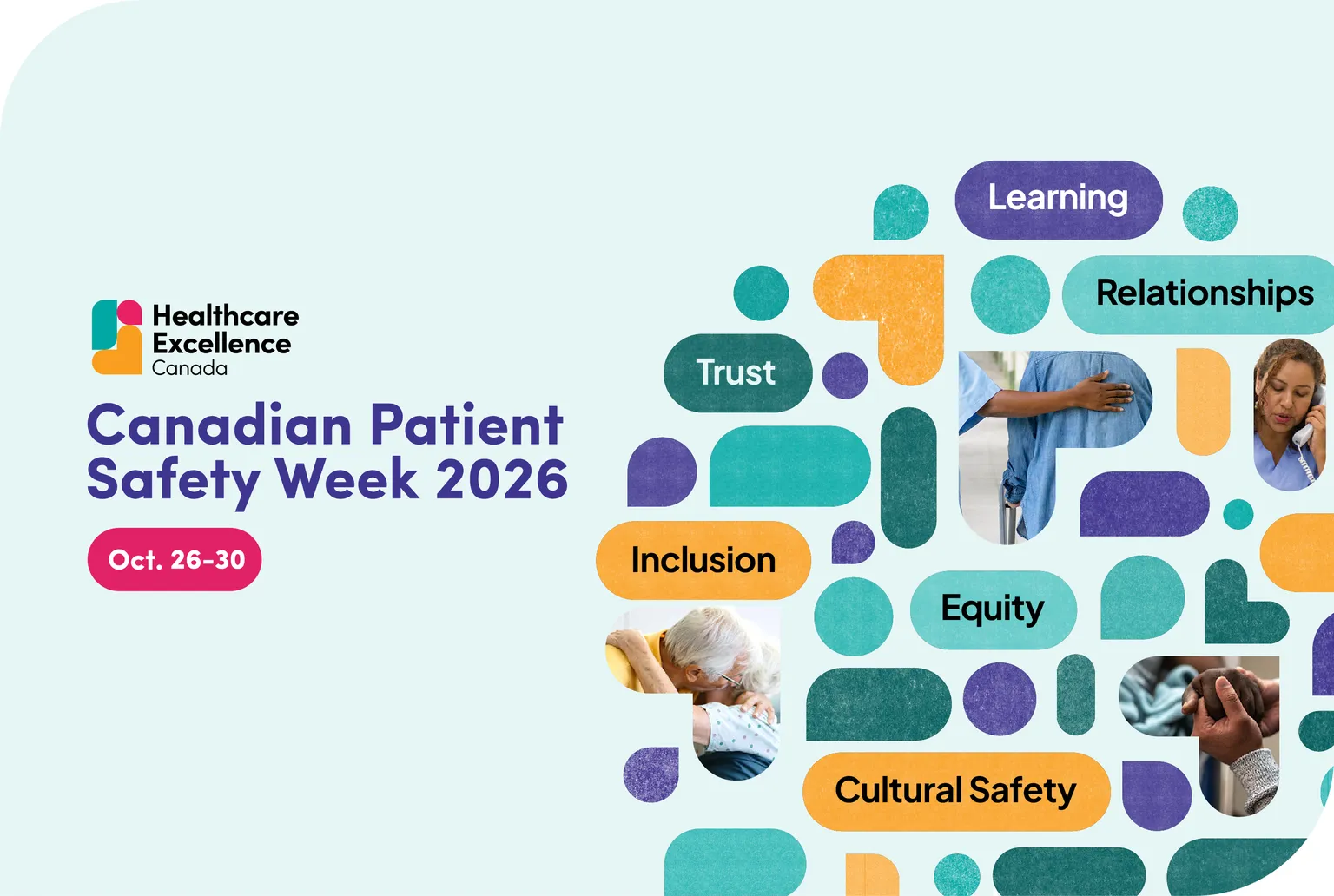
A conversation with a patient, the way a team shares information and decisions about how care is organized can all shape how safe care is and how safe it feels. Some of these moments are easy to see. Others can go unnoticed.
The evidence – and what you shared with us – points to a common idea. Patient safety is a collective responsibility, shaped by what people do every day and by the decisions made across organizations and health systems. In our Voices that Shape Safer Care interviews and in responses from coast to coast to coast, people shared interactions, conversations and ways of working together to make care safer or showed where it could improve.
Here are four of the themes that emerged during Canadian Patient Safety Week 2026.
Partner meaningfully with patients, caregivers and communities.
Heather Thiessen, a member of Healthcare Excellence Canda’s Board of Directors and a patient partner, reminds us that patients are the experts in their lived experience.
Living with two chronic neurological conditions, she has become an active partner in her care. She works with her neurologist to develop care plans based on clinical expertise as well as her own knowledge of her health and experience.
It hasn’t always been this way: Heather remembers the scary and overwhelming feeling of being thrust into ‘hospital-land’ without being invited into conversations or decisions about her care. But when the province of Saskatchewan made a deliberate shift towards a more patient-centred health system, the change in philosophy has supported her to feel more comfortable and confident voicing her needs and concerns.
There is room for patient voices in settings beyond hospitals, too – as the Government of New Brunswick demonstrated in engaging with patients and families to make sure their voices and experiences were reflected in recent updates to the provincial patient safety legislation.
As Joanna Seeley, Healthcare Consultant for the Government of New Brunswick, told us, “If you give the public engagement process the breadth it needs to be a fulsome activity, the policy will better reflect broader system values and benefit patients as a whole.”
Build systems that support safer care
System-level changes can happen through legislation like in the case of New Brunswick. It can also happen within healthcare when healthcare organizations get curious about how people experience care.
Rochelle Currie, Senior Director at Nova Scotia Health prompted the provincial health authority to do exactly that when she noticed that compliance reports were tracking well but weren’t reflecting lived reality. Currie shares her belief that choosing curiosity over judgment is essential to sustaining a culture of safety, and that this learning mindset must be embedded at all levels of an organization.
Driving system-level change is what led Sonia Isaac-Mann to pursue a career as a healthcare administrator rather than the frontline healthcare roles she’d been familiar with as a child. As a citizen of the Listuguj mi'Gmaq First Nation, she grew up in the inequitable and often harmful care that First Nations people have long experienced – even if she didn’t fully understand it at the time.
Today, in her role as President and CEO of the Sioux Lookout First Nations Health Authority, Isaac-Mann is leading efforts to incorporate culturally safe practices within the organization’s programs and services.
“The more control you have over your healthcare services, the better health outcomes you’re going to have,” she says.
Take time to understand the patient and their family
Healthcare is ultimately about people, and the relationships we have can shape safer care.
In Safer Care Through Culture, Connection and Community, palliative care auntie Jackie DeCoteau-Gill emphasizes the power of human connection in her work with First Nations, Inuit and Métis individuals and families in Edmonton, Alberta. She shares how showing up with and for one another with a heart-forward approach can give people the sense of safety they need to face some of life’s most difficult moments.
“Indigenous people have teachings in our heart,” she says, noting that individual spiritual, physical, emotional and mental needs guide her in providing care that is grounded in the well-being of the whole person at a fundamentally human level.
Similarly, “I want to learn who this person is,” is what Victoria Marek, Director of Resident Care and Allied Health, said when a resident at Riverview Health Centre in Winnipeg, Manitoba was having difficult interactions with others in a shared television lounge. It becomes clear for the team at Riverview Health Centre that everyday moments of curiosity – listening, questioning and feeling empowered to act – play a role, too.
Small moments and actions matter
Just as a patient’s health journey unfolds over months and years through appointments, interactions and procedures, safer care is not a single experience. It is a series of moments and interactions that build over time – so small actions matter. And when they fail to meet a patient’s needs, the implications can be profound.
That was the experience of Michelle Grant, a patient partner from Yukon Territory who navigated care across her home province as well as in British Columbia for a serious health issue made even more challenging by the unsafe care she received.
Trained as a social worker, “we’re taught that if somebody says they’ve been hurt, the best thing to do is believe them, even if you have questions, because you can never take that back,” says Grant.
Progress worth building on
It has been more than two decades since the landmark Canadian Adverse Events Study (CAES) that helped to establish patient safety as a healthcare priority in Canada. There is progress to celebrate – but we also have a long way to go.
Ross Baker, a co-author of the CAES study who has been a steady and driving force behind patient safety in Canada, sees lots of opportunity ahead. Considering recent studies and available resources, he discusses the current state of patient safety in Canada and encourages care settings to understand if their current programs are having the desired outcomes.
Though patient safety initiatives are underway every day, in every province and territory of Canada, moments like Canadian Patient Safety Week provide an opportunity for us to take a moment and consider what shapes safer care so we can continue to improve, together.
How people took part
People across the country marked Canadian Patient Safety Week (CPSW) by reflecting, learning and exploring what shapes safer care – and the role each of us plays in creating it together.
Here’s how you collectively engaged:
More than 1,500 registrations for our two Canadian Patient Safety Week editions of Healthcare Excellence Canada’s Spotlight Series.
More than 1,200 downloads from our campaign page.
More than 500 orders from our swag store.
Continue to explore CPSW
Canadian Patient Safety Week is an annual campaign organized by Healthcare Excellence Canada that brings people together around a shared goal: making healthcare safer for everyone.
Canadian Patient Safety Week
Learn moreExplore this year’s theme, campaign resources, stories and ways to get involved.
Voices Shaping Safer Care
Read the blogsWhat shapes safer care? Sometimes it’s a conversation. Sometimes it’s a relationship, a small improvement or a decision that helps someone feel heard, respected and safe.
The foundations of safer care
Start learningThe self-paced learning series is a great starting point for exploring core concepts that underpin healthcare excellence.
How collaboration shapes safer care
Watch the recordingsCatch up on two special Spotlight Series featuring leaders, point-of-care providers and people with lived experience discussing how collaboration across health and social care systems influence the quality and safety of care.